Privacy-Aware Clinical Assessments
Led full-stack delivery of image-based posture and movement assessment workflows—including capture, analysis presentation, history, progress comparison, reporting, and privacy-aware handling of health-related information—for clinicians and wellness professionals.
Product Context
POSTURECO builds healthcare technology for posture analysis, movement assessment, clinical documentation, patient progress tracking, and professional healthcare workflows. PostureScreen and related products support clinicians, fitness professionals, and wellness providers who need clear assessment tools, reliable reports, and simple digital workflows. The product journey moves from new assessment capture, through analysis with quantitative overlays and measurements, to progress comparison across sessions—surfaces where accuracy, privacy, and usability are inseparable.
PostureScreen and RemoteScreen ecosystem
Problem
Clinical and wellness software fails when it treats assessments as ordinary CRUD. Image capture, analysis results, structured findings, historical comparison, and report generation must remain trustworthy across devices and sessions. Practitioners need clarity under time pressure; patients and practices need privacy-aware handling of images and health-related records. The engineering challenge is to make the full assessment lifecycle reliable and explainable without burying domain truth in fragile UI or ad hoc storage patterns.
Winston's Role
As a Senior Software Engineer, I owned full-stack development across application features, backend services, APIs, data workflows, reporting, image-based assessment support, and secure handling of health-related information. I partnered with product stakeholders and domain users to translate clinical needs into stable software, and I stayed accountable for performance, testing, debugging, production issues, and release readiness.
Constraints
- —Health-related images and records requiring privacy-aware access, storage, and presentation patterns
- —Image upload, storage, retrieval, and display pipelines that must behave under real-world network and device conditions
- —Assessment history and progress comparison that demand consistent persistence and correct aggregation over time
- —Reporting outputs that practitioners rely on for documentation—accuracy and clarity are non-negotiable
- —Domain users with specialized workflows; product decisions had to reflect clinical practice, not only engineering convenience
Technical Foundation
- ▸Full-stack product features for posture assessments, movement analysis, patient records, progress tracking, and reporting
- ▸Backend services and APIs for accounts, assessment data, analysis history, clinical workflows, and integrations
- ▸Image-based assessment pipelines: upload handling, result presentation, historical comparison, and review screens
- ▸Database structure, validation, and reporting logic tuned for healthcare workflow reliability
- ▸Privacy-aware handling of user images, health-related records, and clinical documentation data
Challenges
- ◆Balancing clinical accuracy and measurement clarity with simple, time-efficient practitioner UX
- ◆Making image workflows resilient—validation, recovery, and consistent retrieval—when media is large and sessions are interrupted
- ◆Designing privacy into the assessment lifecycle rather than bolting controls onto finished features
- ◆Preserving integrity when comparing progress across assessments so trends remain trustworthy
- ◆Turning practical clinical feedback into durable product behavior without destabilizing production releases
Product
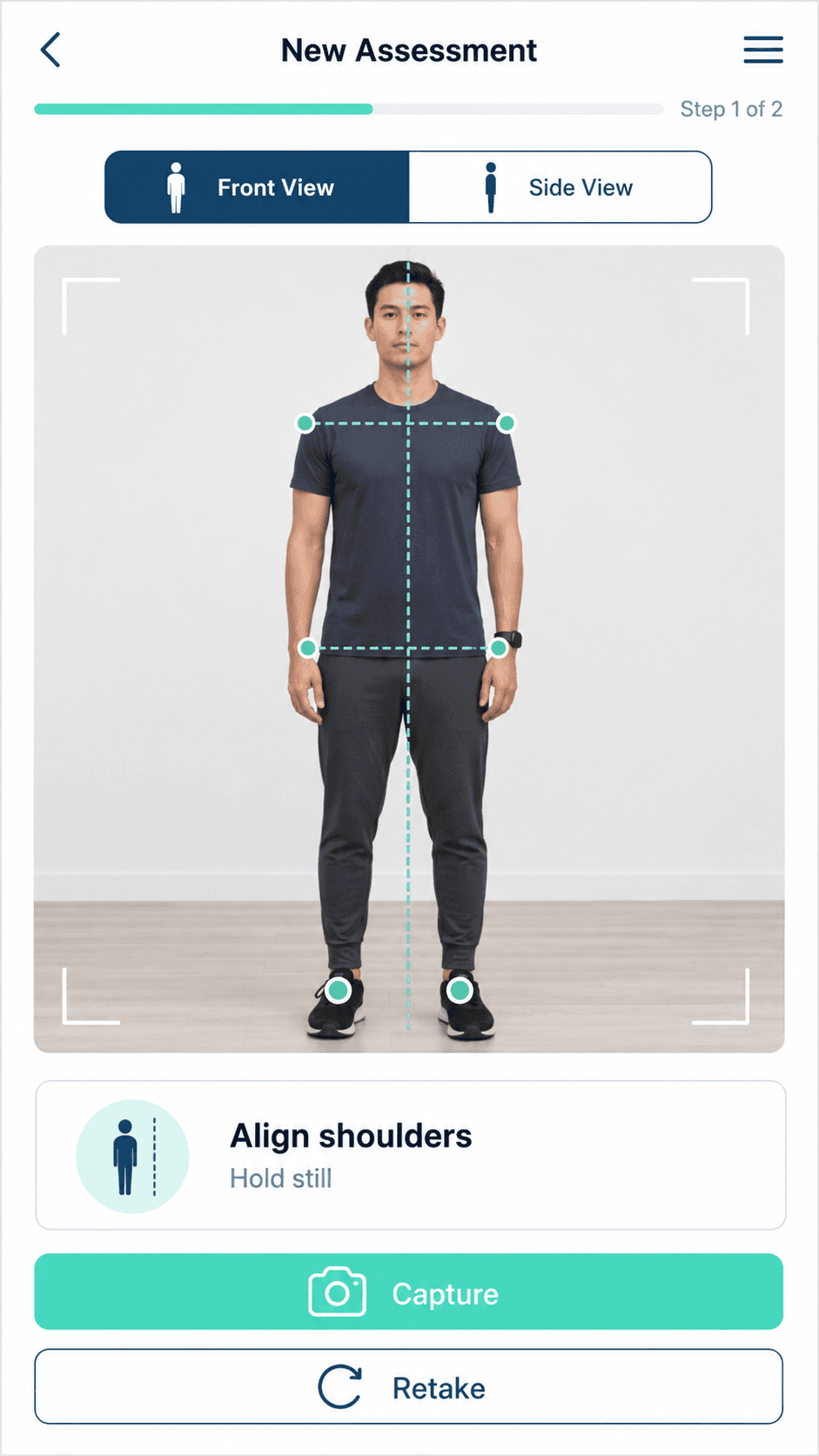
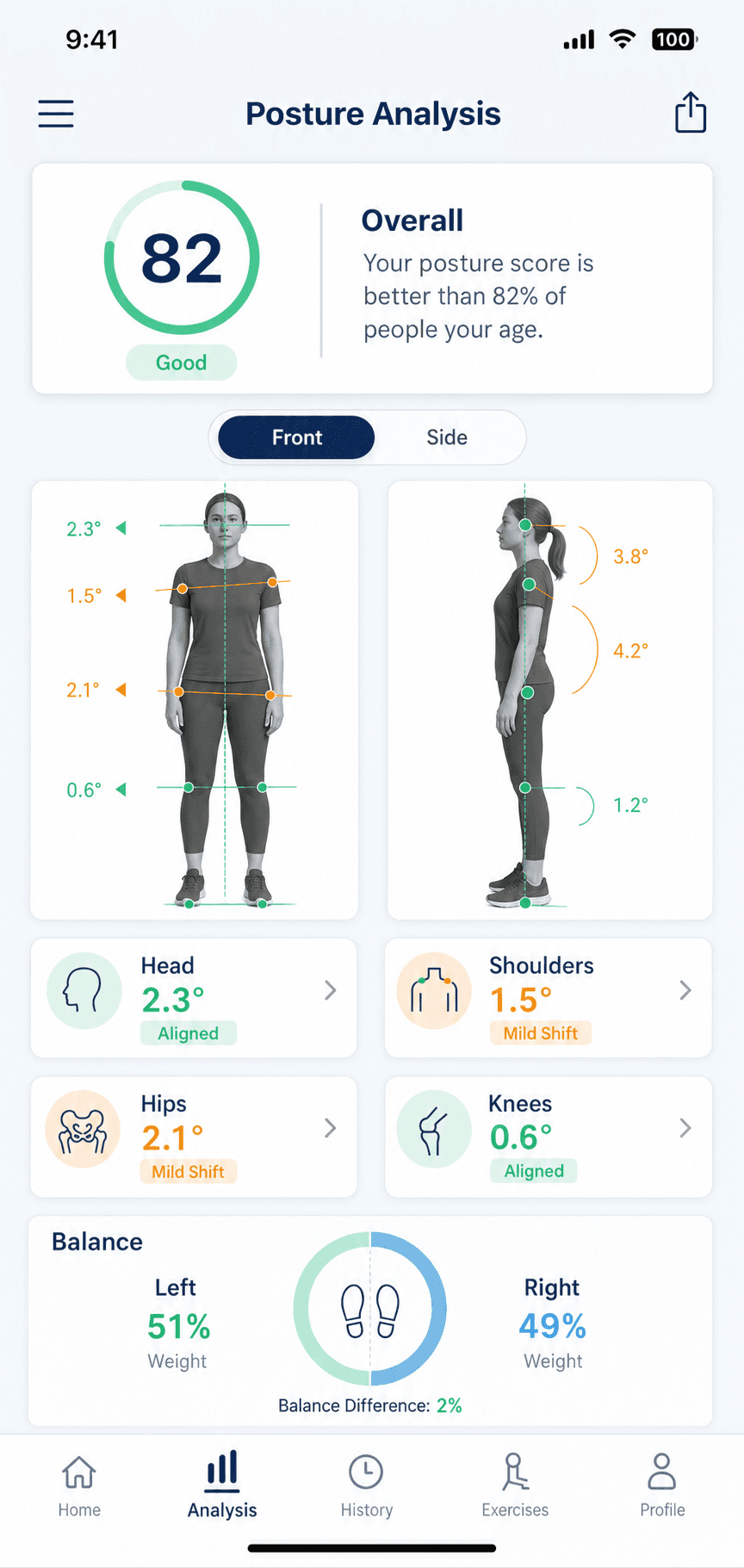
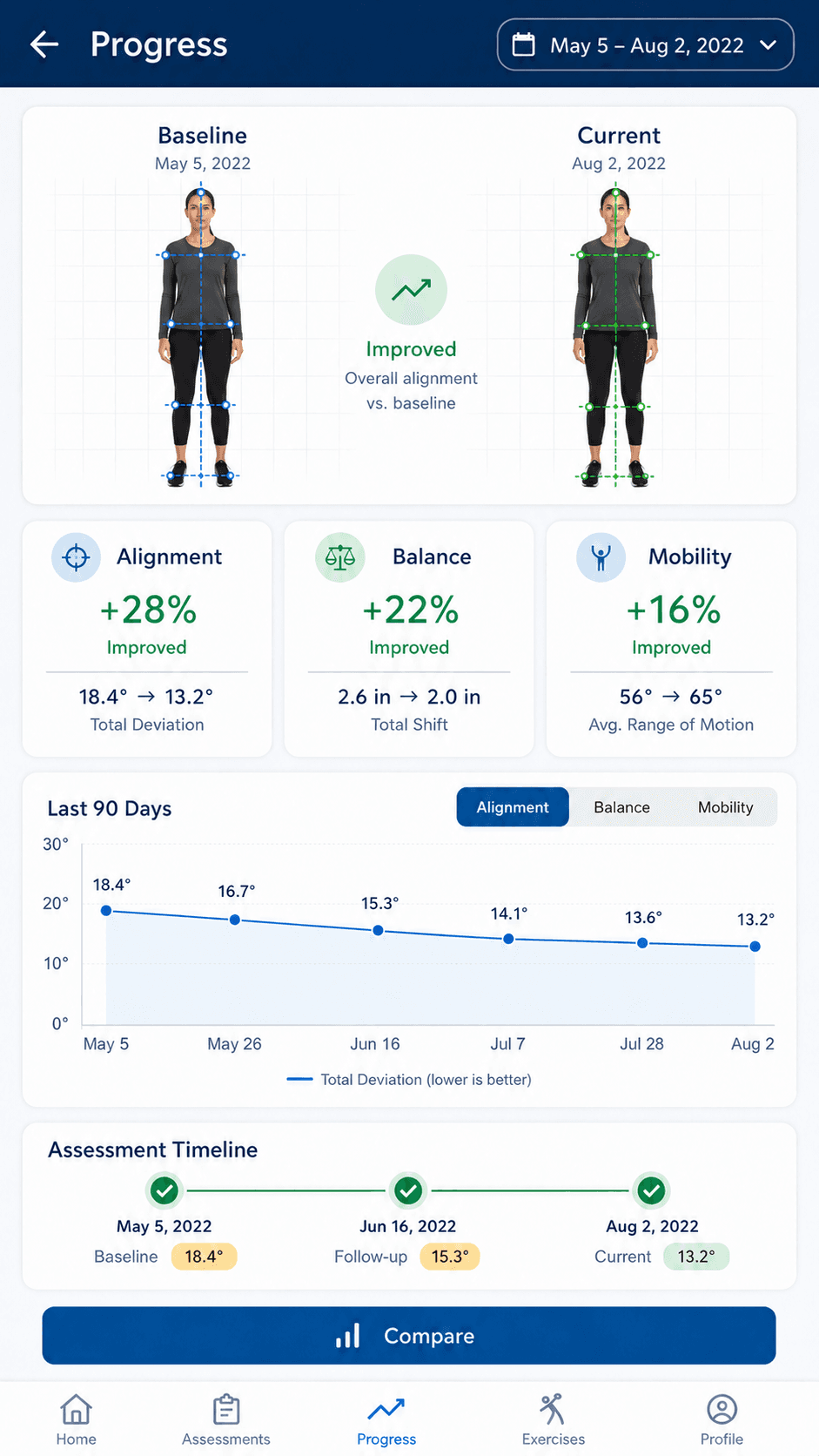
New Assessment · 1 / 3
Product UI shown for context. Details have been generalized to respect confidentiality.
Key Engineering Contributions
- →Built and improved healthcare application features for posture assessments, movement analysis, patient records, progress tracking, and reporting
- →Developed backend services and APIs supporting user accounts, assessment data, analysis history, clinical workflows, and application integrations
- →Improved image-based assessment workflows including upload handling, result presentation, historical comparison, and review screens
- →Implemented privacy-aware handling of user images, health-related records, and clinical documentation data throughout the product
- →Strengthened reporting logic, database structure, validation, and backend reliability for healthcare use cases
- →Drove performance improvements, testing, debugging, production issue resolution, and release preparation
- →Collaborated with product stakeholders and domain users to convert clinical needs into stable, maintainable features
Reliability, Security & Maintainability
Reliability
Assessment integrity was the primary reliability goal: upload pipelines with validation and recovery, consistent history persistence, and reporting paths that aggregated session data correctly. Failures needed to be visible and recoverable—never silently incomplete assessments.
Security
Privacy informed architecture: access controls, careful handling of images and health-related records, and data isolation patterns appropriate to clinical and wellness contexts. Security was treated as part of the product workflow, not a separate checklist.
Maintainability
Clear feature boundaries around assessment capture, analysis, history, and reporting allowed the product to evolve with clinical requirements without collapsing into a single entangled module. Backend structure and validation rules were kept aligned with how practitioners actually work.
Outcome
Delivered full-stack capabilities that made PostureCo’s assessment products more reliable for day-to-day clinical and wellness use—stronger capture-to-report flows, clearer progress tracking, and privacy-aware data handling. Details have been generalized to respect confidentiality.
Lessons
- ◆Healthcare software rewards deep workflow understanding before technical design; the UI is only as trustworthy as the data path behind it
- ◆Privacy is cheapest and most effective when designed into uploads, storage, and reporting from the start
- ◆Image and media pipelines fail in creative ways—explicit validation and recovery are staff-level hygiene, not polish
- ◆Progress comparison and reporting are integrity features: if history is wrong, the product’s clinical value collapses