Cloud Legal Practice Workflows
Engineered SaaS product features and backend capabilities across matter management, calendaring, billing, documents, and integrations for cloud legal practice management—where domain fidelity and data integrity define product quality.
Product Context
Clio provides cloud-based practice management software that helps law firms manage clients, matters, documents, calendars, billing, time tracking, and daily practice operations. Clio Manage centers on how firms actually work: a today-oriented workspace for tasks and schedule, a matter room that aggregates client and case context, and billing and trust flows that must stay accurate. It was a product-focused engineering environment where usability, security, and fast iteration mattered as legal professionals moved more of their practice into the cloud.
Clio Manage
Problem
Legal practice software encodes relationships—clients, matters, time, billing events, trust accounting, documents, and deadlines—that are easy to oversimplify and expensive to get wrong. Features must feel simple for busy professionals while preserving domain rules and multi-firm data isolation. Integrations extend the surface area further. The engineering challenge is to evolve the product quickly without fracturing the matter-centric model or compromising billing and trust integrity.
Winston's Role
As a Software Engineer, I built and maintained web application features, backend services, database logic, integrations, and product improvements for legal workflow users. I worked closely with product, QA, support, and engineering to understand pain points, participated in code reviews and release support, and helped keep production stable during active product growth.
Constraints
- —A complex domain model reflecting real legal practice workflows, deadlines, and billing rules
- —Relational, database-driven features where schema and query decisions have long-lived consequences
- —An expanding integration ecosystem connecting firm workflows to external tools and platform services
- —Users who depend on accuracy and stability for professional practice—not consumer-grade “best effort” UX
- —Growth-stage product velocity: ship improvements without destabilizing core matter and billing paths
Technical Foundation
- ▸SaaS product features for practice management: clients, matters, calendaring, billing, time tracking, and documents
- ▸Backend services, application logic, and database-driven features for a growing multi-tenant legal platform
- ▸Matter-centric workflows that aggregate context for day-to-day firm operations
- ▸API and integration surfaces that extend legal workflows into external tools and services
- ▸Engineering practices oriented to maintainability, testing, release support, and production stability
Challenges
- ◆Preserving legal workflow fidelity so product abstractions match how firms actually practice—not how engineers prefer to model data
- ◆Protecting billing and trust data integrity while iterating on adjacent features and UX
- ◆Growing an integration surface without coupling core practice management to every external tool’s quirks
- ◆Improving usability for professionals under time pressure without sacrificing correctness or auditability
- ◆Making relational schema and query choices that remain viable as firm data volume and feature scope grow
Product
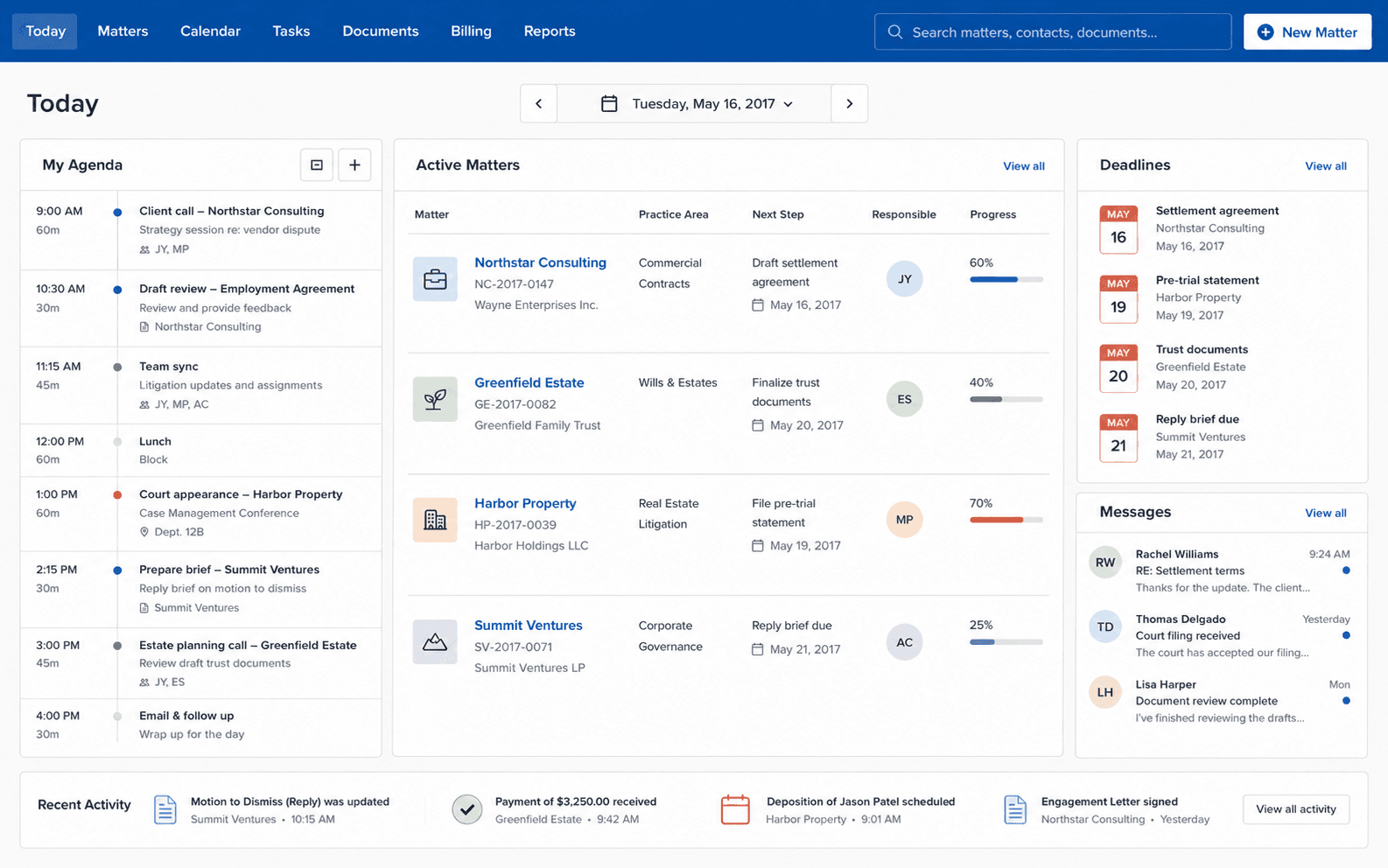
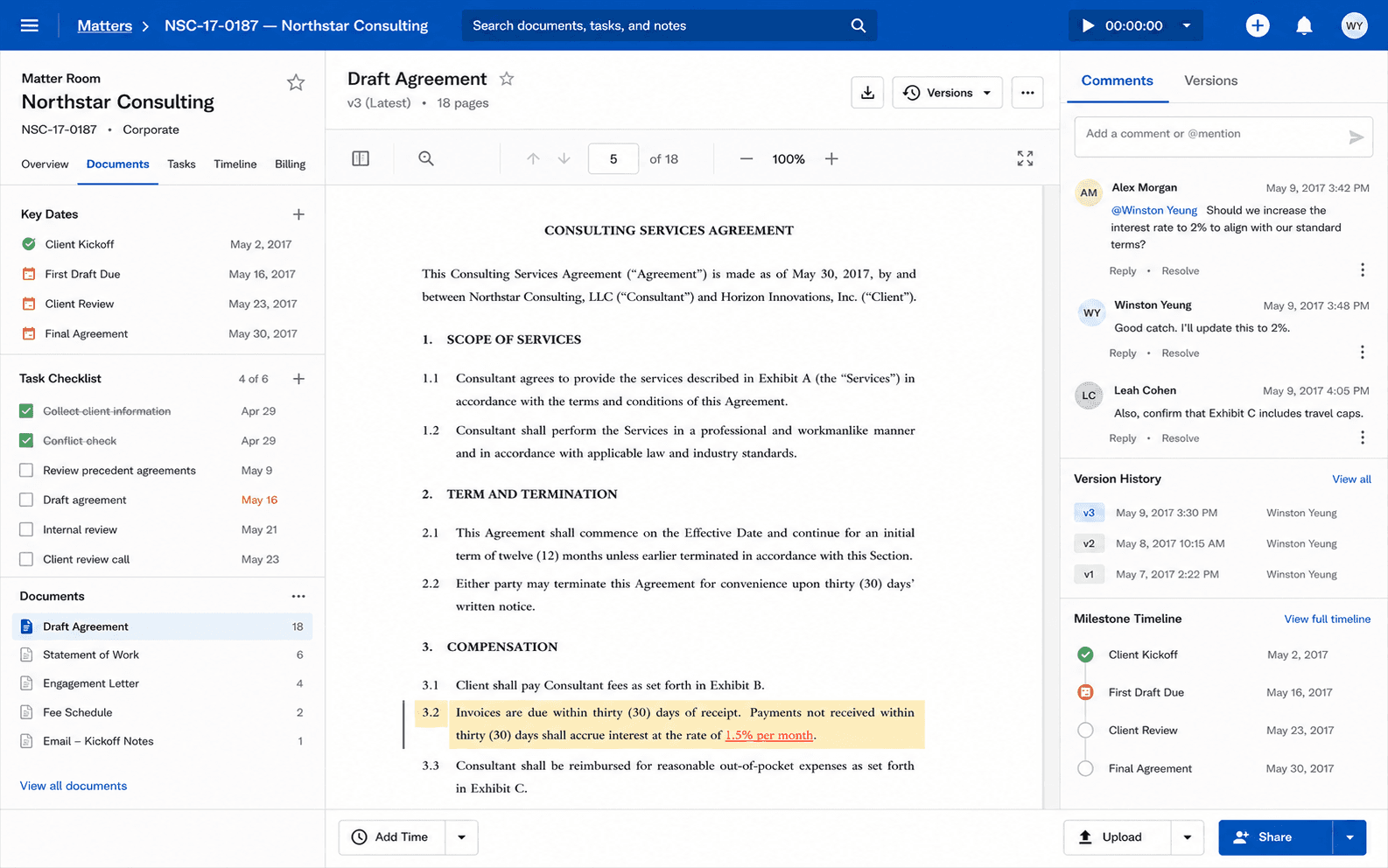
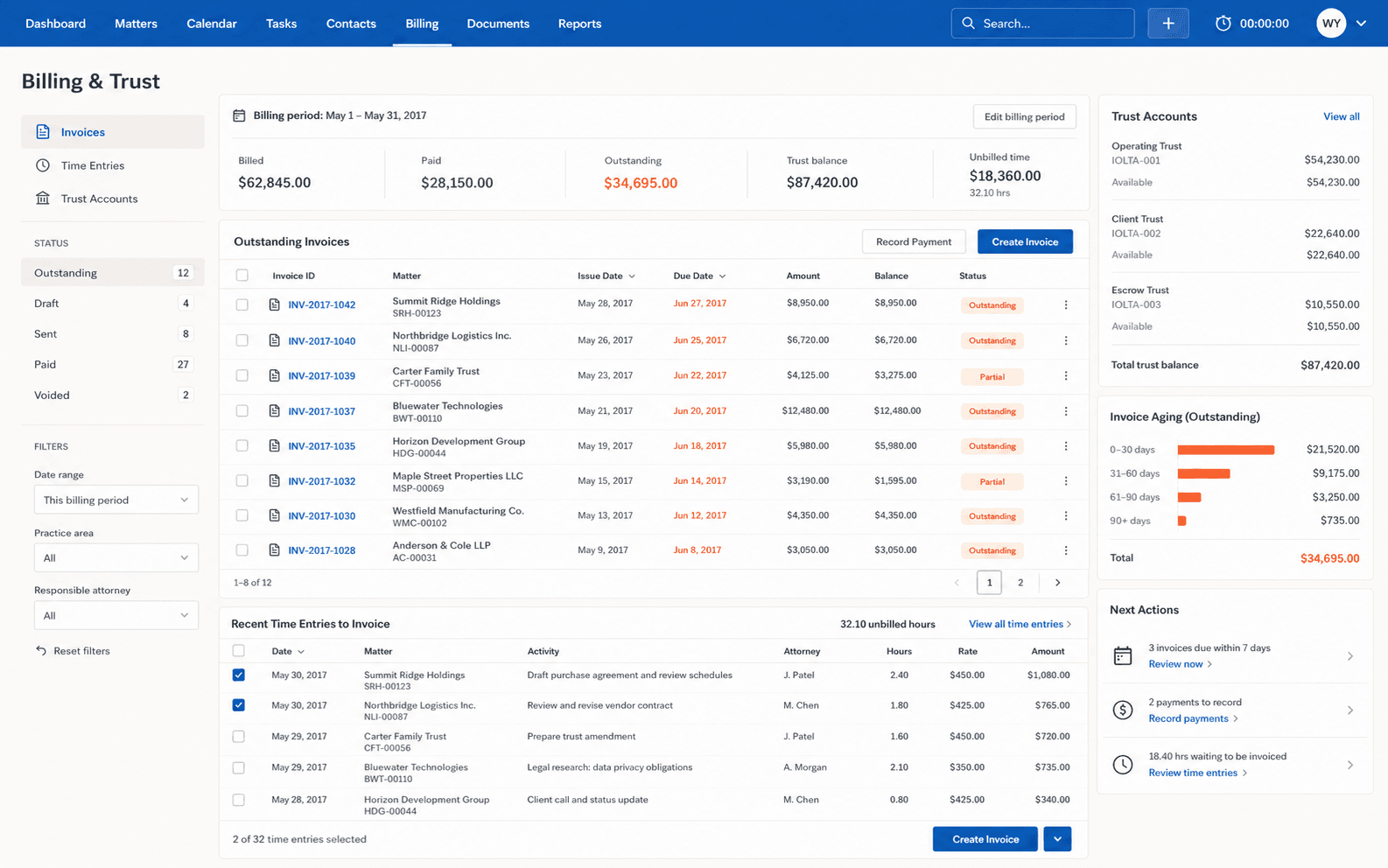
Today Workspace · 1 / 3
Product UI shown for context. Details have been generalized to respect confidentiality.
Key Engineering Contributions
- →Built and maintained SaaS product features supporting legal practice management, client records, matter workflows, calendaring, billing, and document-related workflows
- →Developed backend services, application logic, and database-driven features for a growing cloud-based legal platform
- →Improved user-facing workflows so product areas were clearer, easier to use, and more reliable for law firm users
- →Supported API and integration work connecting legal workflows with external tools and platform services
- →Fixed bugs, improved existing modules, and helped maintain production stability during active product growth
- →Partnered with product, QA, support, and engineering to translate user pain points into practical improvements
- →Participated in code reviews, testing, release support, and technical discussions on maintainability and product quality
Reliability, Security & Maintainability
Reliability
Matter and billing paths were treated as critical systems: validation, careful transaction handling, and stability under active growth. Reliability meant firms could trust the product with professional and financial workflows day after day.
Security
Client and matter data required firm-level isolation and appropriate access controls. Security expectations were inherent to legal SaaS—confidentiality and correct tenancy were part of every feature touching shared platform data.
Maintainability
Domain logic stayed close to the business rules it represented. Integration code was structured to limit coupling between core practice management and external services, so the platform could grow without becoming unchangeable.
Outcome
Delivered product and platform improvements that strengthened Clio Manage for real firm operations—clearer workflows, more dependable matter and billing behavior, and a healthier foundation for continued SaaS growth. Details have been generalized to respect confidentiality.
Lessons
- ◆Legal software rewards domain immersion: billing and matter models are practice rules expressed as data, not generic entities
- ◆Integration ecosystems expand; extensibility and isolation early prevent core product entanglement later
- ◆Relational design decisions are long-lived—staff-level judgment means optimizing for change, not only the current screen
- ◆In professional SaaS, usability without integrity is a failure mode; both must ship together